Writing Advice: Time Jumps
How do you approach a story that happens over a long period of time?
If the point of view and dates are clearly defined, readers will follow the story without difficulty. Time jumps only become confusing when they bounce back and forth excessively and without purpose. If this happens, the reader cannot orient themselves. A confused reader will likely DnF your book and, needless to say, won’t read the sequel. Focus on dates where something directly alters the course of the main plot, or exposes important information about the main characters. This will minimise any unnecessary distraction or noise in the story’s timeline.
Some Examples:
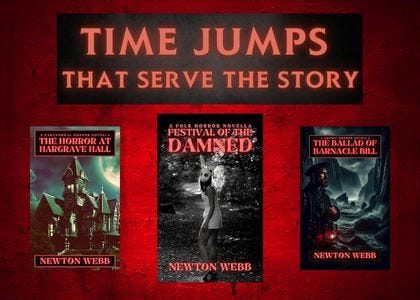
The Horror at Hargrave Hall uses three key dates. The main narration is set in 1832, where the characters are established. It moves to 1842, when they move to the family estate with their son and the danger becomes apparent. An expository diary entry flashes back to 1818 to reveal the origin of that danger.
These dates can be reduced to a simple structure.
1832 answers who they are.
1842 answers what is happening to them.
1818 answers why it is happening.
At around 20,000 words, the novella still required aggressive time compression, so I focused on plot relevant events and avoided filler.
In Festival of the Damned, the structure shifts again. The primary narrative unfolds over a single year, but each of the four main characters is given a dedicated flashback. Each flashback depicts a past sin committed by each character at a different time and place. The novella is folk horror, and the flashbacks serve a moralistic element as well as a chronological one. They provide context, which allows the reader to judge the characters and determine whether the consequences feel deserved or tragic.
In The Ballad of Barnacle Bill, I structured the story in two acts.
Act One is set in 1818 and shows the protagonist experiencing the best night of his life.
Act Two jumps to 1824 and deals with the consequences of that night. Grief has set in, and his responses to it only drive him further towards his nadir (and his potential release).
Because the novella is roughly 10,000 words, there was no space to dramatise a gradual descent into depression and madness. Instead, the story isolates two decisive moments:
Cause in 1818.
Effect in 1824.
FREE Horror Story Compilations
FREE Yuletide Terror: 33 FREE horror stories, including: ‘The Doll House Killer’, ‘Respect’, ‘Justice is Unleaded’, ‘Blade of the Blood God’, and ‘Shadow of the Wolf’.
Tales of Terror: 57 horror stories, including ‘Tales of the Macabre, Vol. 1’, ‘Tales of the Macabre, Vol. 2’, ‘Tales of the Macabre, Vol. 3,’ and ‘Tales of the Macabre, Vol. 4.’
Tales of the Macabre
You can find my stories on Amazon, as Kindle Unlimited, eBook, Paperback or Hardback.
This collection of stories is designed for quick reads, whether over a coffee or during a commute. Either way, they promise to deliver exquisitely disturbing nightmares that gaze without flinching into the abyss—and linger in the mind long after.
FREE on Kindle Unlimited
Available to order on AMAZON.
Welcome to the complete collected works of Newton Webb. Tales of the Macabre, Vol. 1-4 are intended for mature audiences.
Read a collection of free short stories or listen to free audiobooks by Newton Webb on his website.


